
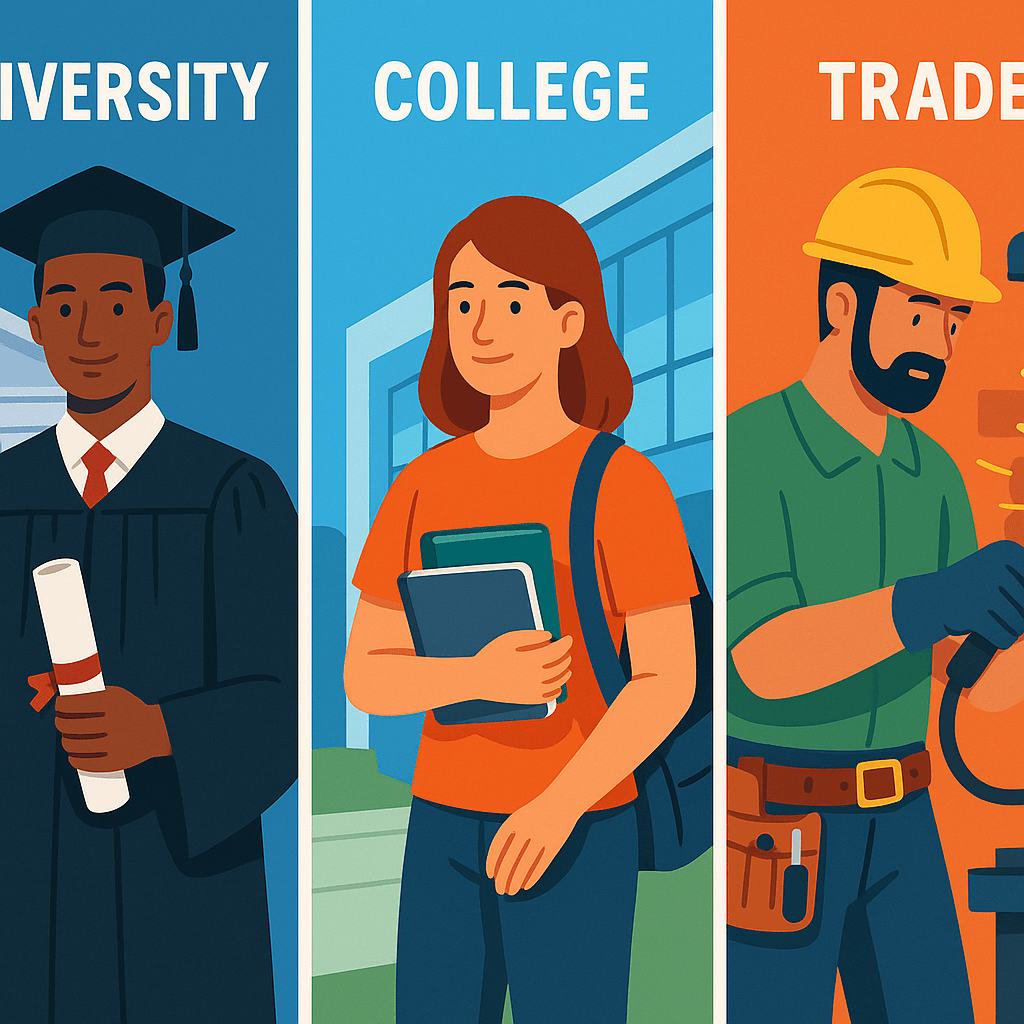
Image generated by AI for Edufunds.co.za on the topic
“university vs college vs trade in South Africa”
Choosing between university vs college vs trade in South Africa is one of the biggest decisions you will make after finishing high school. Each path offers different career opportunities, costs, and study experiences.
In South Africa, this choice is not just about prestige — it is about:
- Your career dreams
- Earning potential
- How long you want to study
- Costs
- Job security
Let us break all of this down, with facts, tables, and some real student voices. 💬
🎯 What is the Difference (university vs college vs trade in South Africa)?
| Path | What is it? | Example Qualifications |
|---|---|---|
| University | Academic, research-focused, longer studies | Degree (BA, BCom, BSc), Honours, Masters |
| College | Practical skills, shorter courses | Diplomas, Higher Certificates |
| Trade | Hands-on technical skills, earn while you learn | Artisan, Plumber, Electrician, Chef |
🏫 University
University as an institution that provides higher learning, it is great if:
- You love studying theories and research
- You want to become a doctor, lawyer, teacher, engineer, accountant etc
- You are willing to spend 3–6 years studying.
But:
- It can be expensive 💸
- Job competition can be high in some fields.
“I’m studying engineering. It’s tough, but I know my degree will open doors. Still, I wish I’d known how much pressure it would be.” – Sipho, UCT student
👩💻 College
Colleges like any other institution of higher learning (like TVET Colleges) focus on:
- Practical skills
- Shorter study periods
- Cost-effective education
Great for:
- Hospitality
- IT support
- Business administration
- Beauty therapy
- Early Childhood Development
Even today many South Africans students still do not realise how valuable college qualifications are, as more matriculants opt for university degrees and diplomas more than the qualifications that are provided by the colleges, and others students choose colleges just because they could not meet the minimum requirements needed to study in the university.
“I’m getting real-world experience and my diploma costs half of what university would cost me.” – Lebo, studying HR at college
🛠️ Learning a Trade
Trades are critical in South Africa’s economy.
Examples:
- Electricians
- Plumbers
- Welders
- Mechanics
- Chefs
- Artisans in manufacturing
Benefits:
- High demand
- Good salaries (sometimes higher than degree holders!)
- Earn while you learn via apprenticeships
“I started earning during my apprenticeship. My friends at varsity are still studying while I’m making money.” – Nkosinathi, 24, Artisan Apprentice
💰 Earning Potential Comparison
| Career Path | Average Starting Salary (Monthly) |
|---|---|
| University Graduate | R12,000 – R18,000 |
| College Graduate | R7,000 – R12,000 |
| Trade / Artisan | R8,000 – R20,000 |
🚨 Remember: Salaries vary by field, experience, and province.
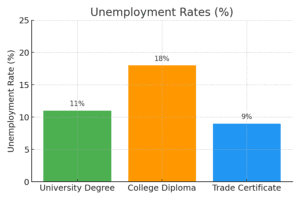 Chart showing unemployment rates for University Degree (11%), College Diploma (18%), and Trade Certificate (9%). Generated for Edufunds.co.za.
✅ Pros & Cons Table
| Path | Pros | Cons |
|---|---|---|
| University | Higher earning potential in some fields, prestige | Long studies, expensive, debt risk |
| College | Shorter studies, cheaper, job-ready | Lower salaries in some jobs |
| Trade | High demand, earn while learning, practical | Physically demanding, sometimes lower social status |
🎓 How to Decide?
Ask yourself:
- Do I enjoy studying theory or working with my hands?
- Can I afford university fees or do I want to earn quickly?
- What kind of lifestyle do I want?
- Do I care about status or just income and stability?
“My family wanted me to go to university. But I love beauty therapy. Now I’m happy and earning well.” – Lerato, 21, Beauty Therapy Student
📚 Helpful Links
- NSFAS Funding Info
- DHET: Technical and Vocational Education and Training
- SAQA Qualifications Info
- Edufunds Blog
✅ Quick Takeaway
✔️ University = great for professional careers, but costly and long
✔️ College = practical, shorter, affordable
✔️ Trades = high demand, earn while you learn, good pay
There is no single “right” path—choose what’s best for YOU.
💡Ways To Pursue Your Dreams
In South Africa, pursuing higher education can be a significant financial burden. But did you know that there are bursaries and scholarships available to help ease this financial strains? South African students can apply for both bursaries and scholarships, depending on their field of study, financial need, or academic performance. These funding options make university, college, and even trade qualifications far more accessible without accumulating debts.
What are bursaries?
A bursary is an offer that is provided by any institution to help a student financially in their studies at a higher learning institution. Bursaries can covers fees, accommodation, groceries and even provide students with pocket money. Bursaries are free, different from loans, which is the money that you will need to pay back. .
📌The Lowdown on Bursary Types
In South Africa, there are different kinds of bursaries and each of them comes with its own rules, since they are provided by different instructions. Here is a breakdown:
• 🦺Field Specific Bursaries:
These bursaries are for students that will be going into the careers like Engineering, IT, Medicine, Teaching, and more.• 🏆Merit Based Bursaries:
These bursaries are for students who have done really well academically.• 🤲Need Based Bursaries:
These are bursaries for students from families that do not earn enough money to cover the university costs.• 🏛️Government Bursaries:
Government bursaries are usually aimed at students from low- to middle-income households. These bursaries often prioritise qualifications that are in high demand in South Africa, such as teaching, healthcare, engineering, and technical trades. You can explore a full list of available programmes in our Government Bursaries section.
• 🏦Corporates Bursaries:
Many large South African companies invest in students through bursary programmes as part of their skills development and community upliftment initiatives. These bursaries often include vacation work and job opportunities after graduation. Browse current opportunities in our Private Company & Trust Bursaries category.
• 🎓University – Specific Bursaries:
These are bursaries that are given out by universities themselves and often come with their own requirements.How to Find and Apply for Bursaries
Now that you know the types of bursaries out there, let us explore how to find and apply for them:
—💻 Online Portal:
Websites like Edufunds Bursaries South Africa 2026, the Department of Higher Education and Training, and corporate career pages regularly publish updated bursary opportunities for university, college, and trade students.
– 🏢University Financial Aid Office:
These offices usually provide information on available bursaries.— 🌟Career Fair and Expos:
Attend these events to learn about bursaries from companies and institutions.💸 Funding Options Based on Your Study Choice
Your study path can also influence the type of funding you qualify for.
- University students often qualify for professional and field-specific bursaries from both government and private organisations.
- College (TVET) students can apply for NSFAS funding as well as sector-focused bursaries in hospitality, business, IT, and engineering.
- Trade & artisan students may receive funding through SETAs, apprenticeships, and industry-sponsored programmes.
To see the latest funding opportunities available across all study paths, visit our updated guide to Bursaries in South Africa for 2026.
🚀Tips for Securing a Bursary
If you want to increase your chances of getting that bursary, Here are some few tips:
🏅Keep Your Grades Up:
Good school grades are important, because bursary providers want to assist people who are hardworking and obtaining good marks.✨Polish Your Application:
When applying for a bursary write a personal statement that will shows potential bursary providers who you are, what are your goals, what have you achievements, and any voluntary or leadership work that you have done, in so doing, you will be making the to understand who you really are and where you want to be in the future.📞Follow Up on Application:
After applying for a bursary, it is always wise to follow up with the bursary provider to show them that you are serious and interested.
Top Bursaries in South Africa — Your Ticket to Financial Freedom
As a South African student, you know that pursuing higher education can be a pricey affair. But fear not, my friends! There are top bursaries available to help you find your dreams. Here are Five of the most sought after bursaries in the county, each with its own unique eligibility criteria and application process.
- NSFAS (National Student Financial Aid Scheme
- Sasol Bursary Scheme
- Eskom Bursary
- Vodacom Bursary
- Funza Lushaka Bursary
Remember, each of these bursaries has its own unique requirements and application process. Make sure to carefully read and follow the instructions for each, it is worth the effort to secure a bursary that can change your life.
The Application Process: Do not Get Left Behind
Identify your Target Bursaries:
🧑💻Research and create a list of bursaries that align with your academic and career goals. Make sure you meet the eligibility criteria and understand the application requirements.📁Gather Your Documents:
Collect all the necessary documents, including your academic transcripts, proof of income, and copy of your certified ID. Always ake sure that they are all accurate and up to date.📃Write a Compelling Personal Statement:
This is your chance to shine. Highlight your achievements, goals, and show them the reasons why you deserve the bursary.
📧Submit Your Application
Make sure you follow the specific instructions for each bursary application, including submission deadlines.
📞Follow Up
After submitting your application do not dissappear in the thin air. Follow up with the bursary providers to confirm if they indeed received your application and ask about the timeline for their decisions, this will not only show your enthusiasm for the bursary, but also ensure that you are not left in the limbo.
Common Mistakes to Avoid:
- Missing deadline
- submitting incomplete applications
- Not tailoring your application to specific bursary criteria
- Failing to proofread your personal statement for errors
❓Frequently Asked Questions (FAQs)
Q: Do I really need to go to university?
- Not always. Uni is great if you want to be a doctor, lawyer, teacher, or anything that requires a degree. But honestly, it’s not the only path. Some people waste years at varsity when they could’ve done a trade or diploma and already been working.
Q: What about college — is it worth it?
- Yep, especially if you want something more hands‑on. TVET colleges offer practical skills like electrical work, plumbing, hospitality, IT… stuff you can use straight away. It’s usually cheaper than university too, and the courses are shorter.
Q: Are trades still in demand?
- Big time. South Africa actually needs more artisans. Think about it — we’ll always need plumbers, electricians, mechanics. Plus, some trades pay really well once you’re qualified and experienced.
Q: How do I even choose between uni, college, or a trade?
- Ask yourself what you enjoy and where you see yourself in 5–10 years. If you love books and research, varsity could be for you. If you prefer working with your hands or want to get into the job market quicker, a college or trade might be better. And remember — you can always study further later.
Q: Where do I find bursaries?
- Bursaries pop up everywhere if you know where to look. Check NSFAS (for uni and college students), specific companies (like mining companies, banks, or municipalities), and even universities themselves often have bursaries listed on their websites. Don’t sleep on career expos either — they hand out info packs with bursary details.
Q: How do I apply for a bursary without messing it up?
- Start early. Read the requirements properly (a lot of people get rejected for missing docs). Keep your ID, proof of income, and your latest results ready. And write your motivation letter like you mean it — don’t just copy and paste some boring template. Tell them why you need it.
Q: What if I don’t get a bursary? Am I stuck?
- Nope. You can try NSFAS if you qualify, or student loans (some banks offer these). Also look at part‑time work or side hustles while you study — a lot of students do tutoring, babysitting, or retail jobs to get by. It’s tough, but it’s doable.
Conclusion
Securing a bursary is not a walk in the park, but the benefits are totally worth the effort. By landing a bursary, you will be able to tackle those troubling tuition fees and focus on acing your studies. A bursary can help you secure a coveted spot at the top university, network with industry pros and set yourself up for a success career.
So, what are you waiting for? Start your bursary search early by exploring verified opportunities in our government bursaries list and private company bursaries section, prepare like a pro, and apply to as many bursaries as you qualify for.